
The Essence of the Trinity
This past Christmas time I was outside my condo hanging up Christmas lights on my patio and deck when my neighbor walked over and started telling me about his son’s recent Bar Mitzvah celebration. After we chatted for a bit about the party, the guest, and he thanked me for the gift I gave his son, and the “awesome” gifts his son received, he asked, Brian, your Catholic, right?
“Yes”, I said: “Born and raised” Why do Christians believe in three gods and Mary? His tone was solemn and earnest.
We don’t, I replied. Actually, we believe in the same God you do. Just differently. This was a lame answer, I know, but I hoped sort of desperately it would suffice.
It did not. He pressed on saying: I mean the Father, Son and Holy Spirit thing. That’s Christian and a Catholic thing. isn’t it? He looked at me with a truly puzzled expression, “I don’t get it”, he said.
Impressed with his knowledge, I replied, “you know what, friend, at times neither do I. But, I did sigh and fumbled my way through all the inadequate explanations that I’d heard as a student in Catholic grade school and high school and higher learning: “God is sort of like water, I said water exists in three states Liquid, Solid, and Gas. Gods like that. Or, like an egg. The shell, the egg white and the yolk.”
Three parts, one egg. Or a three-leaf clover, or a tree. The roots, the trunk, and the branches – but they all make up one tree or one egg, right?
The look of confusion on his face only deepened. For a minute his politeness warred with his curiosity, but then he blurted out the inevitable: “What’s the point of believing in three gods” “Why three?” What difference does it make?”
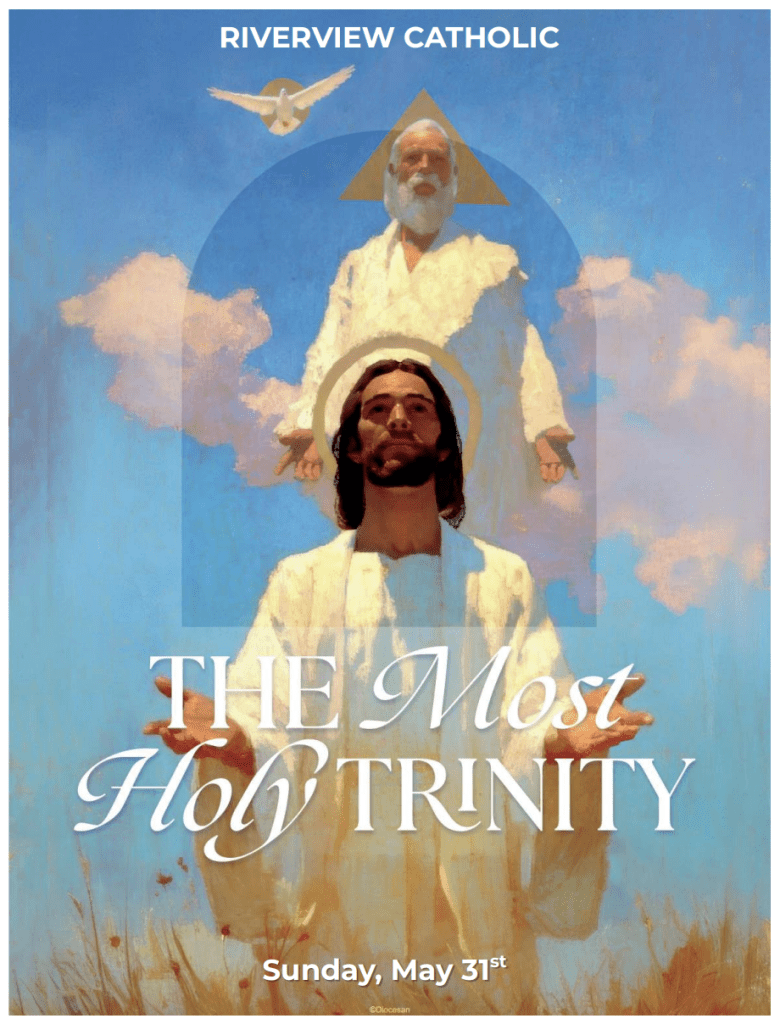
This week, we celebrate Trinity Sunday, and try, for better or for worse, to contemplate the very question my neighbor asked me: “What difference does three make?” It’s a tough question, particularly if we take the Holy Trinity for granted and yet find our belief irrelevant to daily life. While most of the feast days in our liturgical calendar celebrate dramatic and suspenseful events — Jesus’s birth, the Resurrection, the coming of the Holy Spirit at Pentecost — Trinity Sunday lacks glitter. It’s abstract and boring. Just water, eggs, trees, and three leaf clovers, who cares?
I recall this past Holy Saturday (seven weeks ago). I was sitting in the church after having just finished decorating the church for Easter Sunday. Alone with my thoughts, I could not help from starring at the beautiful mural (as I often do) in the sanctuary. I noticed many of the depictions of people and events within the mural. I was drawn especially to the depiction of the Trinity which is in the middle of the mural. My mind started to race with many thoughts including the Solemnity we celebrate this weekend, Holy Trinity Sunday and how this mural depicts also our individual life and situations, our culture and our parish life today.
When we look at the news on TV or read articles, we are often presented with news of violence, segregation and building walls between us. There is the reality of individuals and indeed some countries speaking out and defending their rights at the expense of dialogue and cooperation with other nations. People of different religions in the same country are often not only disagreeing with each other; they are actively fighting each other. Sadly, there is division where there could be unity, there is aggression where there could be understanding, and there is suspicion where there could be trust.
The Trinity offers us a model of sharing, belonging and community. It also challenges our individualism and our demand that our rights be met all the time. The Trinity asks to be mindful of our responsibilities to those around us in our families, our neighborhood and our parish community.
This Easter season invited us to be in relationship with Jesus; it awakened us to a way of living, loving and relating. We are invited to be like the Trinity-living in absolute relatedness.
In the Christian tradition, when we begin our prayers, whether as individuals or a community, we do so by making the sign of the cross and calling on the power and presence of the Trinity. When we pray, Glory Be … we do the same. We deliberately and consciously ask the Trinity be part of the prayer and our daily life. Perhaps on this Feast of the Trinity we could say these prayers slower and let their meaning become part of us in a more intimate and personal way.
*** The comparisons in the essay (water/ice/gas; egg; etc.) are only limited analogies meant to express, in a simple way, that God is one and yet also distinct in Father, Son, and Holy Spirit.